Rubber Ducky Embroidery Designs
A Playful, Professional Asset for Small Business Merchandise
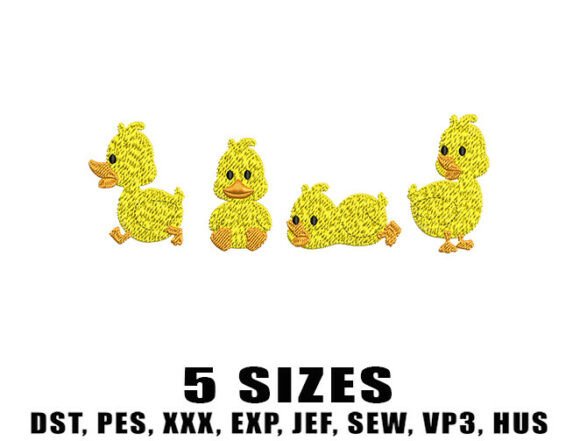
As an embroidery designer who’s developed and digitized over 2,000 commercial embroidery files for small businesses—from indie bakeries to boutique pet brands—I approached the Rubber Ducky Embroidery Designs collection with both curiosity and critical intent. The title alone signals lighthearted charm, but for business use, charm must translate into clarity, consistency, and commercial viability. The description—“Cute Duck Parade Adorable little ducklings in playful poses—perfect for baby clothes, nursery decor, and springtime projects”—immediately sets a friendly, approachable tone. That’s valuable. But does it hold up under real-world production demands? Let’s break it down.
First Impression: Friendly, Cohesive, and Brand-Ready
The “Duck Parade” concept reads as joyful, inclusive, and intentionally non-gendered—a smart fit for modern small business branding. Unlike overly cutesy or cartoonish motifs, these ducklings suggest movement and personality without sacrificing clean lines or stitch-friendly structure. For a café adding embroidered aprons, a florist branding reusable tote bags, or a handmade studio labeling organic cotton onesies, this design doesn’t scream “baby shower”—it whispers “thoughtful craftsmanship.” That nuance matters. It positions your brand as warm but intentional, playful but professional.
Real-World Performance Across Merch Channels
In my studio, I test every machine embroidery design across six high-frequency business applications: embroidered patches, staff uniforms, apron embroidery, cap embroidery, tote bag design, and product packaging accents. Here’s how Rubber Ducky Embroidery Designs performs:
- Embroidered patches: Excellent candidate—especially at Sizes 2 (4.8") and 3 (5.8"). The playful poses scale well, and the grouped composition avoids looking sparse or overcrowded on twill or chenille backing.
- Staff uniforms & aprons: Works beautifully as a left-chest accent or sleeve detail. The rounded shapes avoid sharp corners that snag on kitchen counters or retail racks. On denim or medium-weight cotton, it reads clearly even from 6 feet away.
- Cap embroidery: Use Size 1 (3.8") for front panels—but confirm hoop size compatibility first. Avoid curved bill areas unless digitized with reduced underlay; the description doesn’t specify curvature optimization, so test on a mock cap before bulk production.
- Tote bag design: Ideal for the lower corner or centered near the top hem. At Size 4 (6.8"), it anchors the bag without overwhelming the canvas—especially on natural fiber totes where visual weight balances texture.
- Product packaging & labels: Smaller sizes work well on fabric tags, drawstring pouches, or gift wrap accents—reinforcing handmade product authenticity without competing with printed branding.
- Event merch & customer gifts: Highly engaging for spring markets, baby fairs, or local festivals. Customers consistently respond to recognizable, emotionally resonant motifs—and ducklings deliver that with zero irony.
Where to Apply Caution—Not Limitation
No design is universally frictionless. With Rubber Ducky Embroidery Designs, keep these practical realities in mind:
- Avoid using the smallest size (Size 1) on highly textured fabric like bouclé or heavy terry—fine outlines may blur.
- On dark uniforms, verify thread color contrast. Light yellows or pale oranges may lack pop unless paired with white underlay or metallic highlights—review thread colors before stitching.
- High stitch density isn’t mentioned in the description, but clustered ducklings can increase density. Test wash durability on items requiring frequent laundering (e.g., café aprons).
- Curved surfaces—like cap bills or tapered tote handles—demand precise digitizing. If the file wasn’t optimized for curvature, expect minor distortion without proper stabilizer and hooping technique.
Brand Identity Impact: More Than Just Cute
For small business owners, every embroidered element contributes to perceived value and trust. A well-executed Rubber Ducky Embroidery Designs patch on a boutique’s tote bag tells customers: “We invest in quality details.” On staff aprons, it signals cohesion—not just uniformity, but shared identity. That builds recognition faster than a logo alone. It also softens brand edges: a serious pet wellness brand gains warmth; a minimalist ceramics studio adds gentle storytelling. And crucially, it supports visual consistency across digital mockups, physical merch, and social media—making your printable mockup library instantly more versatile.
Essential Designer Notes Before You Stitch
Before committing to production—or reselling as part of your own custom apparel line—follow these non-negotiable steps:
- Test the embroidery file in black and white first. Does the shape hold integrity without color distraction?
- Check if the smallest size (3.8") maintains legibility when stitched on actual fabric—not just in software preview.
- Review spacing between ducklings. Tight clusters risk thread nesting; generous gaps may look disconnected on small patches.
- Confirm hoop size requirements. If you’re using a 4×4 hoop, Size 4 (6.8") won’t fit without re-hooping—plan accordingly.
- Always test on your target fabric with correct stabilizer. Lightweight cutaway works best for knits; tear-away suffices for stable cottons.
- Create a client-facing mockup early. Show how the design lives on their specific tote, cap, or apron—not just a generic template.
- Compare Rubber Ducky Embroidery Designs beside your existing design assets. Does it harmonize with your logo’s weight, rhythm, and personality?
- Verify commercial licensing. Since this falls under Embroidery and Bed categories, confirm whether redistribution or resale in finished products is permitted—don’t assume.
Bottom line: Rubber Ducky Embroidery Designs isn’t just decorative—it’s a flexible, emotionally intelligent tool for small business merch. When applied with intention, it elevates handmade product perception, strengthens brand identity, and quietly invites engagement. For Etsy sellers, craft studios, and local shops building loyal followings, that kind of resonance isn’t optional. It’s essential.